How to land first job
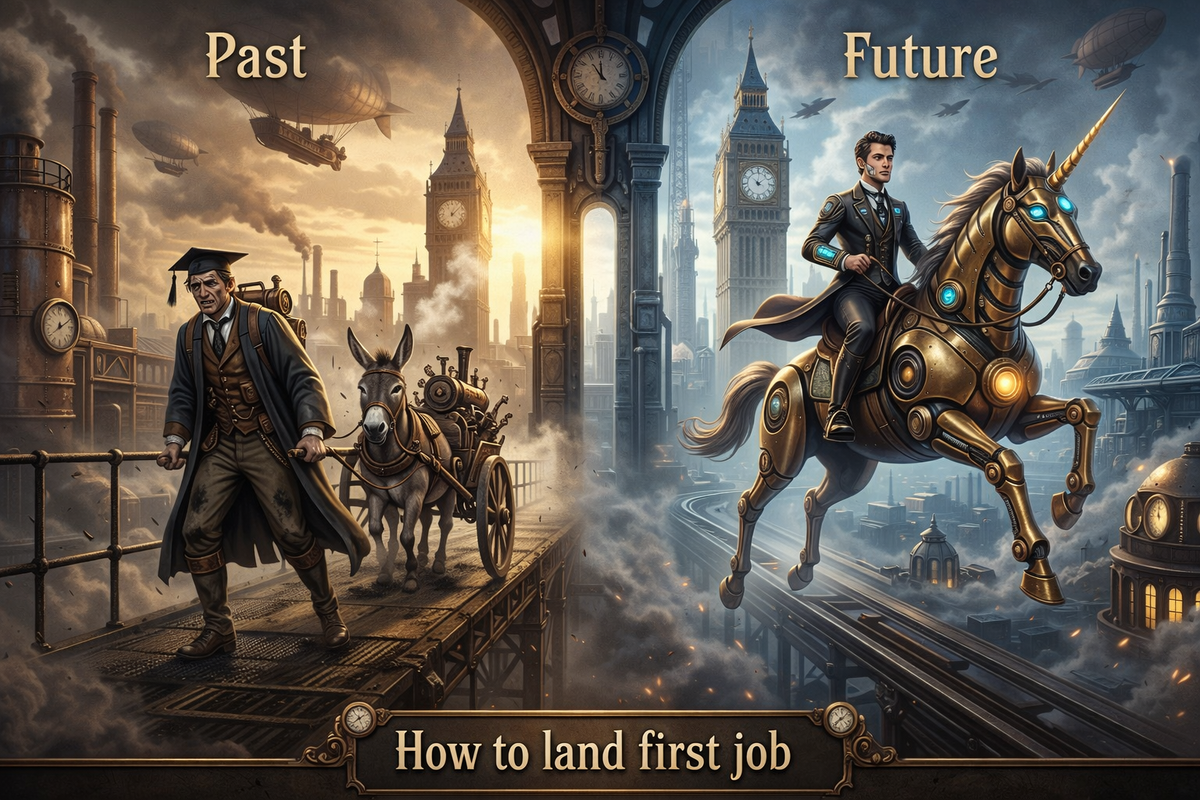
Entry-level jobs are fading in era of AI. Here is how to land one systematically:
Introduction
I have hired people. And I have laid many people off.
Those two sentences hold more truth and weight than many career books combined, because I’ve sat on both sides of the hiring table. Over the past decade, as a managing partner, I’ve hired around thirty critical roles while having to let go of more than three hundred individuals. These moments were shaped by COVID, economic downturns, and now, most profoundly, the rapid emergence of artificial intelligence.
Here’s a hard truth I believe many new graduates need to understand early: For at least the next five to ten years, and possibly forever, I (or many companies) don’t see myself hiring traditional entry-level positions.
Cruel? Perhaps.
Necessary? Absolutely.
The earlier you see reality as it truly is, the sooner you can pivot, adapt, and reclaim agency.
Why Entry-level Job Is Fading
The classic first job operated on a simple social contract. Graduates entered the workforce with limited practical skills but enough credentials to look trainable. Companies hired them, invested time, energy, and resources into developing them into capable employees.
Artificial intelligence and especially agentic AI workforce is swiftly reshaping that layer first : automation, harness, workflows and skills can already outperform junior-level employees across many tasks: basic research, data entry, content creation, preliminary coding, synthesis, and project management.
For many businesses, especially startups, lean companies, or highly competitive industries, the economic logic becomes clear: Why hire an unproven graduate when a capable AI agent can deliver faster, cheaper, and consistently? In the past decade, I’ve trained dozens of junior analysts and programmers, investing significant resources into their growth. Some flourished, yet many remained reliant on continual guidance, and others left within a short time for various reasons. As a founder, each departure and every unfulfilled potential became expensive lessons. In a realistic sense, in this era of agentic AI, I find agentic workforce way more capable and trustworthy than any of my previous junior-level employees combined, surprisingly and unmistakably in the field of technology, programming, product development, and analysts.
Adapting to the New Reality
So what should graduates do?
First, discard outdated scripts. Gone are the days when good grades, polished résumés, and obedient patience reliably translated into secure employment. Today’s market rewards demonstrable initiative, proven usefulness, and practical output. Employers, myself included, increasingly favor candidates who have tangible evidence of their capabilities, candidates who have already built something real.
The new employability question is not “Will someone hire me?” but rather:
Can you identify and solve real-world problems?
Can you build something tangible (the MVP) with limited resources?
Can you quickly adapt and iterate based on market feedback (find the PMF)?
Can you leverage AI tools to multiply your productivity and creativity?
Building as Proof of Value
When evaluating candidates now, I place immense value on evidence of real-world engagement, even if their entrepreneurial efforts failed. By building something, no matter how modest, teaches you lessons you can’t learn in any classroom or corporate training program. It forces you to encounter customer needs, market dynamics, financial constraints, resource limitations, emotional resilience, and the stark gap between theory and practice.
A candidate who has genuinely tried to create something is, to me, infinitely more valuable than someone who has spent years insulated within a large organization performing one narrow task. Big organizations can build competence, but they can also hide dependency. I trust individuals who have confronted uncertainty, navigated ambiguity, and learned from real-world friction.
Actionable Advice for graduates
If you’re young and entering the radically reshaped landscape, here’s how to thrive:
1. Build a Personal AI Assistant:
Use AI to stay updated in your industry, summarize complex research, automate repetitive tasks, or manage your schedule. Make this AI your multiplier.
2. Solve Small, Real Problems First:
Find a specific problem, preferably one you personal experience, and use AI tools to create practical solutions. It might be automating a small business process, streamlining a workflow, or designing a niche product. Solve one small thing well before dreaming bigger.
3. Create and Maintain a Portfolio of Real Outputs:
Forget polished résumés filled with vague claims. Instead, assemble a digital portfolio showcasing completed projects, AI prototypes, dashboards, published analyses, workflow automations, or even a small business experiment. Evidence always beats assertions.
4. Publish Your Learning Process Openly:
Demonstrate your adaptability and transparency by sharing your iterative process, mistakes, insights, and improvements publicly. This honesty is invaluable and attracts attention.
5. Turn Learning into Marketable Outputs:
Convert your insights into tangible deliverables like tutorials, summaries, cheat sheets, tools, or mini-courses. Let your learning create immediate value.
- Run Micro-Experiments:
Rapidly prototype solutions using AI and test them in small experiments. Observe real-world reactions, gather feedback, and iterate swiftly. Adaptation beats perfection every time.
- Develop Problem Notebooks:
Every week, use AI to help document and analyze problems you encounter or observe. Rank them, research solutions, prototype quickly, and reflect. This builds powerful pattern recognition over time.
Agency Is the New Security
Ultimately, this transformation is about reclaiming agency, and empowering graduates not to wait passively for the market to declare them useful, but to actively demonstrate their value first.
Yes, traditional entry-level jobs are fading. In their place emerges a new landscape filled with possibilities: one where initiative, adaptability, and the courage to build become the new credentials.
This future is uncomfortable yet powerful. Those who embrace the paradigm shift will enter the workforce with certainty, clarity, and agency. They’ll enter, not seeking approval, but offering undeniable value. And they will thrive as they learned to build wings when the ladder start to sway away.