The Twilight of Advertising
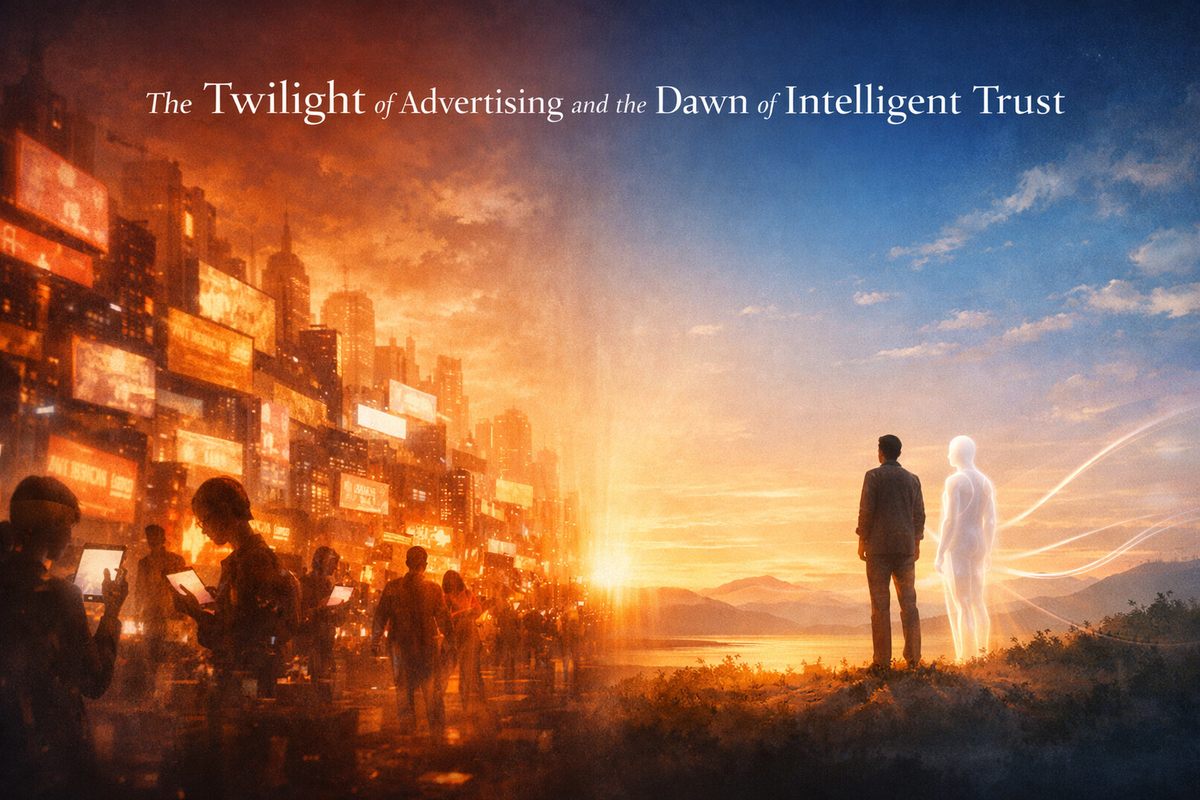
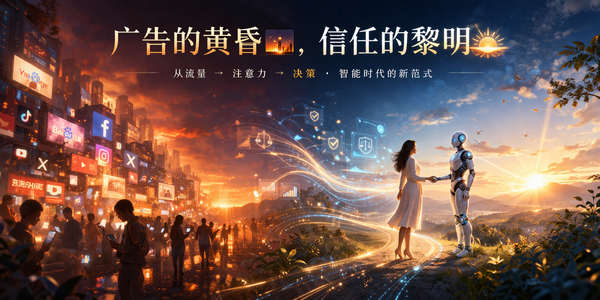
The Twilight of Advertising = The Dawn of Intelligent Trust
From Silicon Valley’s wildest dreams to everyday street conversations, OpenAI’s move into advertising has sparked a subtle yet profound debate: Should AI giants rely on advertising as their revenue stream, or is this approach fundamentally flawed?
Advertising, once the backbone of the internet economy, has undergone dramatic transformations, from the traffic-driven Web1 era of Yahoo and Google, and Facebook, to the attention-hungry Web2 world dominated by TikTok, YouTube, X and Instagram. Yet today, we stand at the precipice of a seismic shift: transitioning from an economy built on capturing attention to one centered on aiding decisions, ushered in by the rise of AI agents.
But let’s return briefly to our opening question: Can OpenAI genuinely thrive on advertising?
In the age of Web1, the game was simple, as web traffic equaled revenue. Platforms boasting the most eyeballs commanded the greatest profits. Moving into the Web2 landscape, advertising refined itself, burrowing deeper into user behaviors, emotions, and subconscious impulses. Every like, every scroll, every lingering glance became data points fueling precision-targeted ads. Yet this model quickly approached a natural limit: human attention, finite and easily fatigued.
Today, people willingly pay for YouTube Premium just to escape “precisely annoying” advertisements. This signals that the attention economy, once so lucrative, has plateaued. Attention alone can no longer sustain the enormous valuations and dreams held by the tech titans of our time.
Amidst this change, trust is undergoing a fascinating evolution. The conventional advertising model built a bridge of attention between consumers and brands. However, as AI integrates deeper into daily life, this bridge trembles under the weight of a new reality: trust shifting from platforms to personalized AI agents.
People are no longer asking AI “What can I buy?” Instead, they are asking, “What is the best choice for me?” This seemingly minor shift fundamentally alters how decisions are made, both personally and professionally.
On the consumer side, rather than scrolling endlessly or comparing deals, future consumers simply instruct their AI: “Book the best-value flight,” “Find the ideal international school for my child,” or “What supplements suit my health profile?”
The investment sector experiences even deeper disruptions. Investors previously depended heavily on market reports, expert analyses, and gut instinct. Now, AI provides immediate, comprehensive, and nuanced insights, integrating massive data flows, pinpointing subtle market shifts, and accurately evaluating risks and opportunities. Trust in AI is surpassing traditional analytics, reshaping financial strategies and practices fundamentally.
This transformative shift means advertising itself must evolve dramatically. No longer just a showcase aimed at capturing attention, future advertising will become seamlessly embedded within AI-driven decision-making processes. Users will no longer view ads directly; instead, their AI agents will analyze, compare, simulate, and execute decisions transparently and effortlessly.
In the Web4 era, advertising targets not users directly, but the algorithms guiding their choices. Businesses no longer compete merely for exposure but for AI recognition as the best, most trustworthy option. Demonstrating value and trustworthiness will grant brands privileged positions within AI recommendation engines, thus reshaping the competitive landscape.
Yet, OpenAI’s foray into traditional advertising may only be a sideline narrative. The true driver behind astronomical valuations aka the “dream-to-market” ratio is the immense creativity and productivity unleashed when individuals merge with AI agents (OpenAI Codex, Claude Code, OpenClaw, to name a few). This “intelligent emergence” means anyone can become a self-contained, hyper-efficient “One-Person Company,” seamlessly moving from inspiration to execution. This represents the true, thrilling promise of our AI-driven future.
Consider real-world scenarios:
Imagine an entrepreneur from mainland China, navigating the complexities of setting up a company in Hong Kong, acquiring residency, educating their children abroad, and managing overseas assets. Rather than diving into endless searches or consuming countless ads, they entrust an AI agent to chart the optimal course, assess risks, and recommend top service providers.
Picture a homemaker seeking the perfect nutritional supplements. No longer influenced by advertisements or social media endorsements, she consults her AI health assistant, which uses detailed personal medical data to recommend and procure precisely what she needs.
Visualize a global executive frequently organizing complex business travels. He no longer compares prices on travel sites but simply instructs his AI assistant to optimize every aspect of his upcoming global itinerary seamlessly.
Imagine an investor requiring sophisticated portfolio management and asset allocation strategies tailored to specific risk profiles and financial goals. Instead of traditional advisory firms, they rely on AI-driven analyses that dynamically monitor and adjust investments in real-time.
As advertising’s twilight deepens, what new dawn emerges?
It is the dawn of an unprecedented “Intelligent Trust Economy.” In this new paradigm, advertising no longer comes in the form of embedded content or influencer endorsements. Instead, it is built upon rigorous transparency, fairness, and efficiency enabled by AI agents. Trust between users and their AI agents forms a virtuous cycle 🔄, successful decisions boost trust, encouraging further reliance on the agent, thus refining future outcomes and intensifying this positive feedback loop.
This represents the true miracle of intelligent emergence, as every individual empowered by AI becomes the master of their own consumer choices, investment decisions, and life strategies, unlocking unlimited potential and creating boundless value.
In this new epoch, the “dream-to-market” ratio is no longer merely the fantasy of tech giants but becomes tangible reality driven by the genuine creativity and productivity of AI-enhanced individuals.
Advertising won’t vanish entirely. It will quietly recede into the background, silently embedded in the fabric of intelligent decision-making systems, serving users so seamlessly that it becomes invisible.
Thus marks the true twilight of advertising and the magnificent dawn of an Intelligent Trust Economy. ❤️🔥