Core–Wave–Cash-Trash System
A Life & Capital Framework for Volatile Times
What to protect, what to explore, and what to let go when the world won't stop spinning
In a world shaped by volatility, cycles, noise, and narratives pretending to be signals, I found myself slowly but irreversibly coming to a place of clarity, after surviving cycles of crash and burns. The shift of enlightenment was a long arc of pattern recognition, seasoned by years of compounding win or loss, experimentation, recalibration, and a growing desire to design a life and capital system that could truly last decades and centuries.
This is how I arrived at Core – Wave – Cash – Trash four-mode system.
I. The Framework
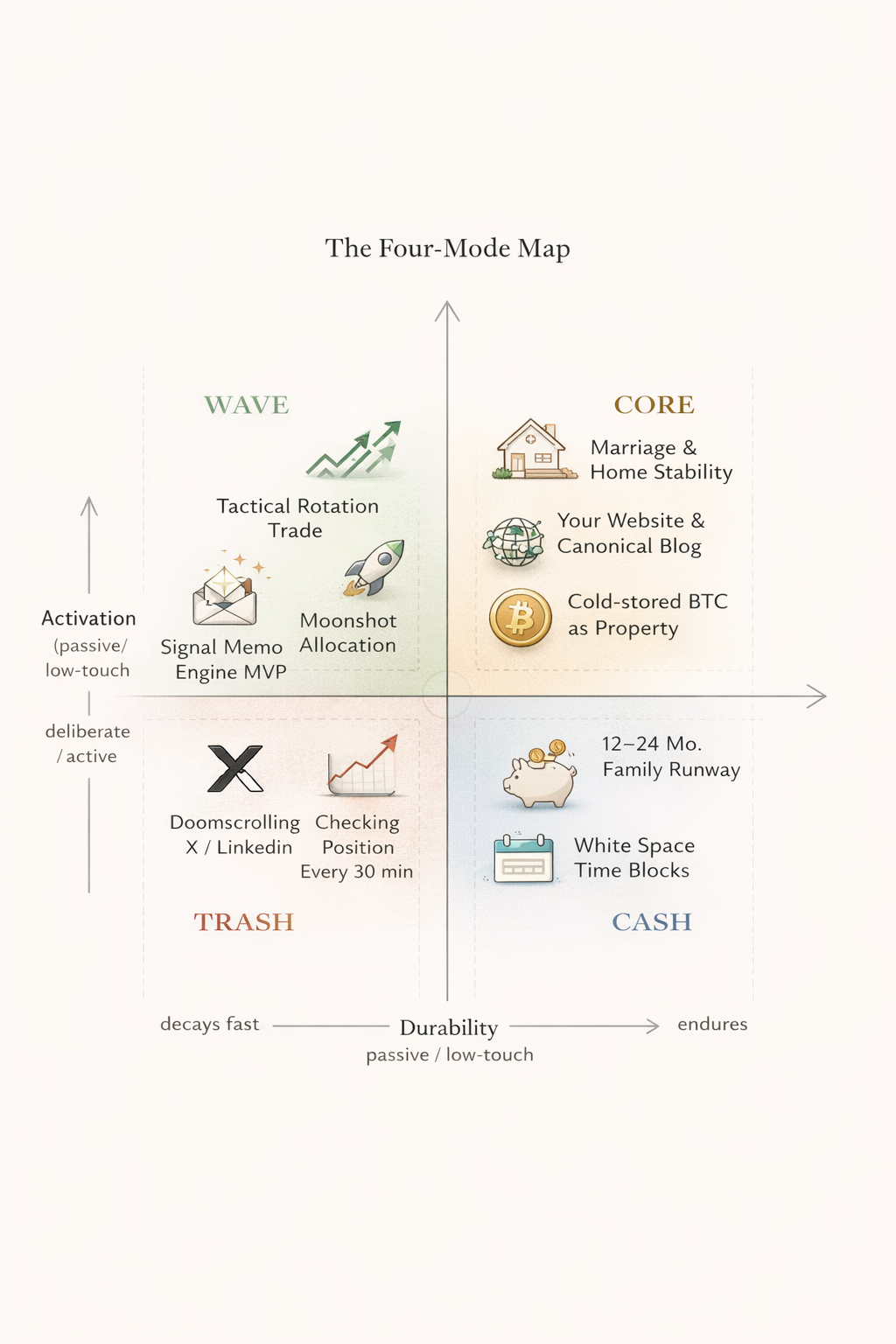
- Core is what I protect. It defines my sovereignty, my identity, my values. It must survive the worst day. It needs to remain intact if I disappear for 10 years. It includes family, health, cold-stored BTC, my digital name.
- Wave is what I explore. It is how I ride trends, tactically allocate, test theses, and sometimes miss. It includes smart bets, rotating narratives, moonshots. The wave is governed by kill-switches, exit liquidity, and correct position size.
- Cash is what I preserve. It is what allows me to rest, pivot, breathe. It is the capital buffer as well as psychological slack. An option instead of optimization.
- Trash is what I discard. It pretends to be Wave, sometimes even Core. But it erodes attention, drains energy, and poisons clarity. Trash is compulsive Telegram groups, doomscrolling X, overreaching trades, identity-inflated roles.
II. A Flashback from 2025
In May 2025, I took a leveraged long position in Bitcoin. I pledged bluechip digital assets collateral (mainly WBTC and ETH) to borrow around $500,000 in USDT from Compound protocol, which I deployed into the same asset: Bitcoin. It was leverage by two. I initially considered 3x, but with some internal negotiation and my AI co-pilot nudging, I scaled it back.
I didn’t lose money.
But I didn’t win the way I wanted.
Back in 2022, my wealth bot helped me call the bottom nearly to the day. That tool became part of my identity, an always-winning, cycle-detecting oracle. I rode that success like a badge of pride, and it worked, until it didn’t.
By October 10th, 2025, the market had peaked. On October 11th, a black swan ripped through the crypto ecosystem. Some blamed Trump. Others suspected a Binance internal liquidation cascade, a kill-switch event that dropped USDE to pennies within the exchange. Market makers were eliminated.
My bot didn't scream; it whined. My confirmation tools blinked in confusion. There was no climax, just slow bleed.
I held. I hoped. I doubted.
I exited the position on November 3rd, 2025, swallowing a 2% loss on a $500,000 leveraged exposure. It wasn’t ruinous, but it was personal. I paid back the loan. Closed the loop. Ego bruised. Heart sore.
And yet, it may have been the wisest decision I had made in years with hind sight.
Because I exited with Core intact.
(The other things not intact: my ego, the bot's legacy, the performance chart. But it is completely ok.)
III. The Rules of the Game
1. Core must never be violated by Wave.
No matter how high the potential return, if it touches health, sovereignty, or sleep, it’s a non-starter.
2. Wave must be killable without drama.
Every Wave entry must have a sizing rule, time horizon, and emotional stop-loss.
3. Cash is allowed to do nothing.
If Cash makes me feel stupid, I remind myself: staying solvent and sane is alpha.
4. Trash has no redemption arc.
No matter how smart it sounds, if it eats peace, clarity, or dignity, it goes.
5. Core improves without me. Wave adapts without me. Cash pauses without me. Trash decays if I’m not there.
That’s how I classify. That’s how I breathe.
IV. What I Now Know
The market may be too busy to reward me. The crowd may be too distant to understand me. One day, my future self needs to look back and smile at the decisions made when the sky was noisy and the signal was thin.
Core is sacred. Wave is signal. Cash is space. Trash is noise.
That’s how I play this game now.
© Robin Xie, written for my 84-year-old self, so she can laugh gently, knowing that we didn’t try to be perfect, only to be free.