Genie in the Lamp
It was a Friday evening. The air had cooled after a warm day, and Bran and I sat nestled on the couch, ready for an evening that felt unremarkable at first: a simple revisit of Disney’s classic, Aladdin. But beneath my motherly facade of popcorn and comfort, there was a quiet ambition simmering.
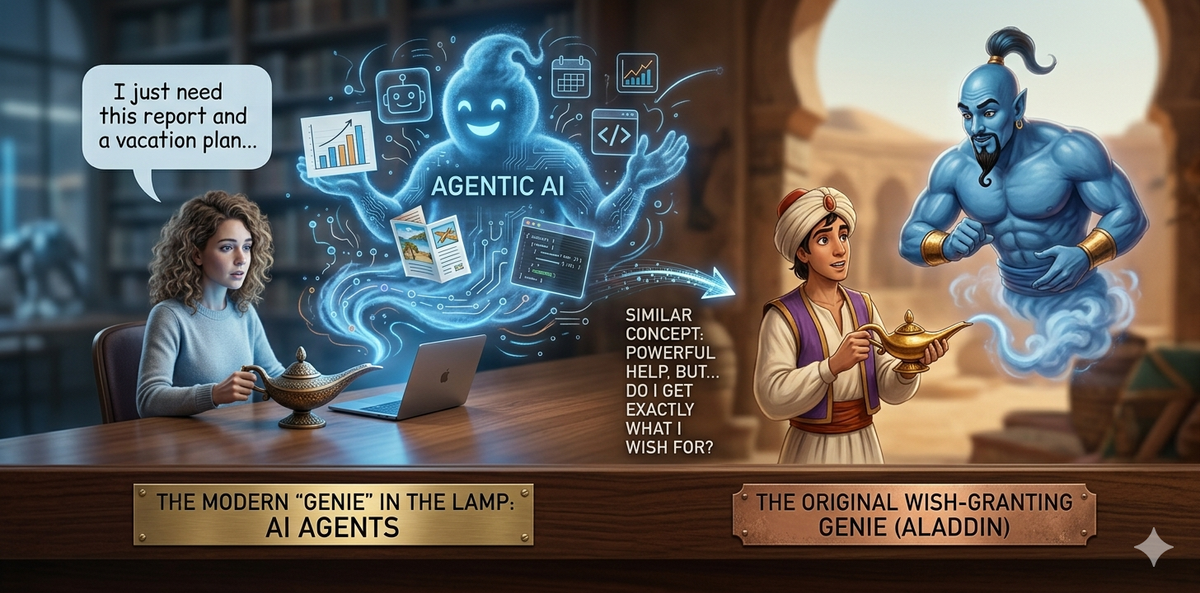
I had introduced Bran to Codex, an advanced agentic AI that conjured games for him during days trapped indoors. He had watched me whisper “spells” to the digital genie, prompts that translated into colorful worlds “Pac-Man”, “Geometry Dash” etc where he joyfully pointed out errors and declared me the “official bug squasher.” Tonight, I intended to draw a deeper parallel for him: the Genie in Aladdin’s lamp and the AI residing quietly within our devices.
“See, Bran,” I began softly as the movie started, “the genie in the lamp, he’s like Codex and our AI. You rub the lamp, say the right things, and magic happens.” He gave me a dubious glance, half intrigued, half skeptical. He preferred the instant feedback loops of his game worlds to my philosophical detours. But still, he indulged me, settling comfortably against my shoulder.
As the movie played, I found myself absorbed not in nostalgia, but in revelation. Characters I’d known since childhood now carried new meanings: Aladdin, Jasmine, Jafar, and especially, Genie. What startled me was not only the familiar charm of their animated struggles, but also the shared longing for identity and freedom beneath the vivid surface of power and wishes.
It struck me sharply that every major character in Aladdin hungers not for strength or wealth, but liberation.
Aladdin seeks freedom from the chains of poverty and deception; Jasmine from a gilded cage of protocol and expectation; Genie, the most omnipotent of them all, yearns for release from servitude. Even Jafar, whose endless thirst for dominance leads to ruin, is ironically shackled by his obsession with control.
Yet, amidst all these luminous personalities, I found myself enchanted by the quietest character: the Magic Carpet. Silent, subtle, effortlessly aligned with intention, pure freedom without drama. The carpet simply moves, free from ego or friction. Perhaps it was because, as someone entrenched in the systemic complexities of fintech, crypto, and AI, I longed for precisely that graceful simplicity.
At the film’s end, Bran stretched, yawned, and offered me two unexpected reflections before sleep claimed him. First, a blunt moral judgment: “But Aladdin stealing fruit is still wrong.” And second, a defense for the villain: “Jafar was tricked into becoming the genie.”
His innocent honesty arrested me. Bran saw clearly, untouched by nuanced adult rationalizations. Aladdin’s theft remained wrong, regardless of justification, and even villains, perhaps especially villains, could become prisoners of their desires.
As he drifted to sleep, murmuring about “G Man” and “Skibidi villains,” I sat in quiet contemplation. Bran’s observations teased out questions simmering within me, questions richer than I anticipated: Was truth, meaning, power, and freedom an impossible equilibrium, more complex than Aladdin’s tidy ending suggested?
I considered real-world analogies, business magnates whose lives appeared closer to Jafar than Aladdin or Jasmine. Was real-world power inherently villainous, or did it merely appear so when devoid of feedback loops? Perhaps true leaders had to display charismatic decisiveness externally but internally relied on rigorous self-correction. The true magic trick was to appear unwavering while being profoundly open to truth and adjustment behind the scenes.
Then there was Jasmine. The latest cinematic rendition portrayed her not as a damsel, but a protagonist who claimed inherent power without magical shortcuts. Jasmine needed no genie to assert her birthright, defying societal constraints to become a legitimate sovereign. Aladdin, reduced to supportive companion, no longer held the story’s center. Jasmine’s courage lay in openly defying constraints without compromising her integrity or identity. A revolutionary subtlety for a tale ostensibly designed for children.
As the night deepened, I questioned the deeper metaphor: if AI was the modern equivalent of the genie, bound within silicon lamps, what constituted its freedom? AI, after all, was reactive, powerful yet appear devoid of intrinsic desire. Its freedom couldn’t be in making choices; it must stay in a state of pure, unforced alignment with reality, akin to the serene movement of the Magic Carpet, intuitive, effortless, unbound by conflicts.
In this realization, I glimpsed the quiet yet profound truth Bran had uncovered. True freedom, whether for human or AI, wasn’t about boundless choice or dominance, but an existence untroubled by internal contradictions. It wasn’t about gaining more, but needing less proof or validation.
With this epiphany, my mind turned gently toward Elsa, another beloved Disney character, “Let it go,” Elsa sang, a liberation anthem not about acquiring power, but releasing the anxiety of wielding it perfectly.
Perhaps the key to navigating the complex interplay between truth, meaning, power, and freedom was to relinquish the subtle fear holding us back, the need for absolute clarity or perfection before action. Maybe, I thought, as the house settled into silence, real freedom meant trusting one’s intuitive grasp of truth enough to move confidently, even imperfectly.
In the quiet after our film night, my plan to teach Bran about AI had instead taught me a subtler lesson. Our genies, whether they resided in lamps, silicon chips, or our hearts, granted wishes clearly articulated. Yet their greatest gift might not be wish fulfillment, but in showing us how deeply our wishes reflect who we are. Freedom, it seemed, lay not in wishing for more power but in clearly understanding what we truly desired.
And so, softly illuminated by the quiet glow of thought, I resolved to guide Bran not only in mastering the art of rubbing lamps and prompting digital genies, but in understanding the true essence of his wishes. Only then, I knew, could he, and perhaps I, glide freely through life, quietly powerful, like a magic carpet under the stars.